

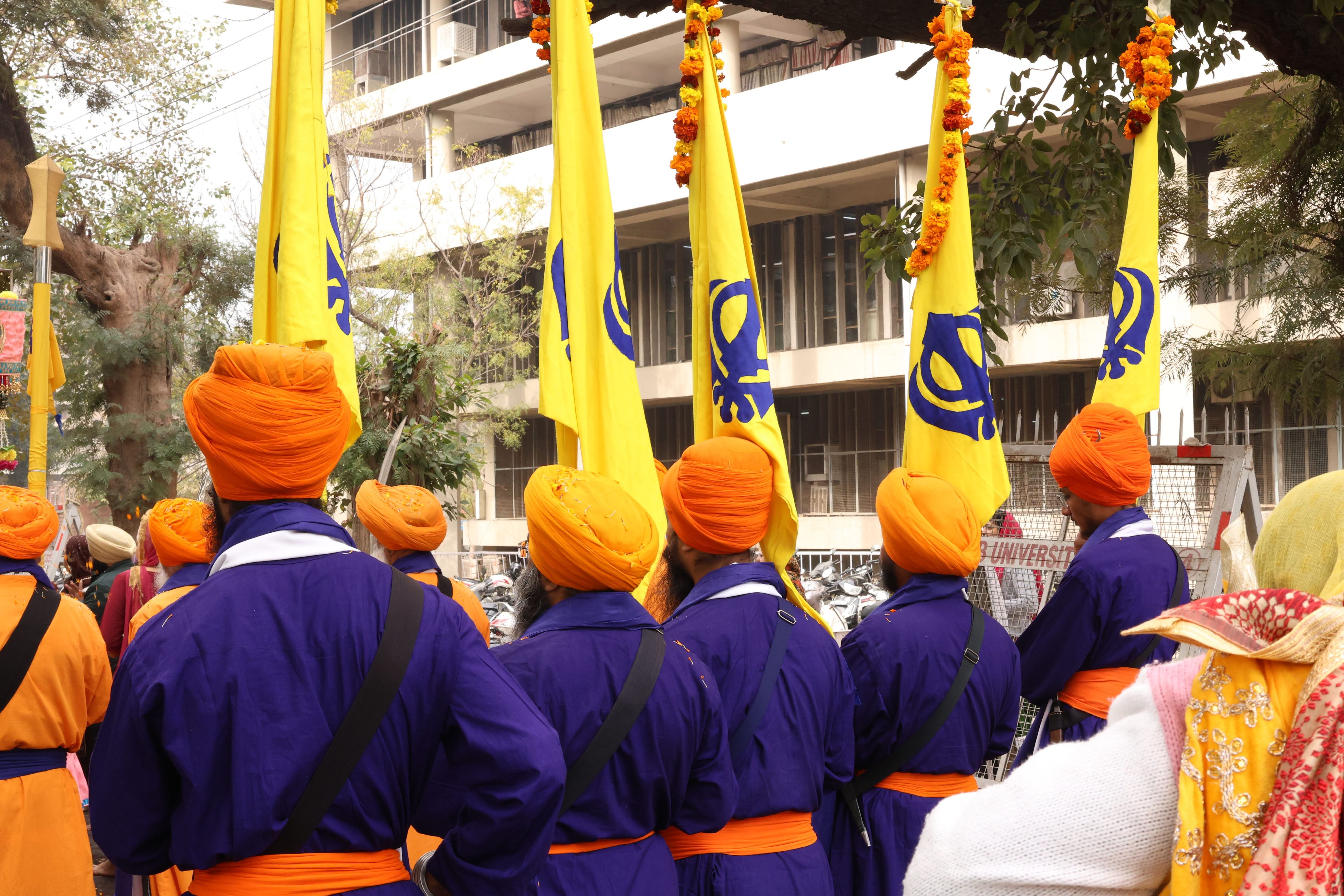
Introduction
Sikhs are a vibrant, diverse, and globally dispersed community, yet their stories are often misrepresented, oversimplified, or overlooked in mainstream media.
Reporting on Sikhs is frequently influenced by colonial-era frameworks, orientalist stereotypes, and misunderstandings of their religious and cultural identities. These misrepresentations can perpetuate social prejudice, reduce this dynamic community to mere symbols or tropes, and erase the richness of their lived experiences.
This guide seeks to decolonize reporting on Sikhs by emphasizing Sikhi—the living spiritual, ethical, and social framework of the Sikh tradition—as opposed to reducing it to a static religion.
Sikhi is a way of life that centers on equality, social justice, selfless service, and devotion to the One Creator.
Understanding these principles is crucial for producing journalism that is both accurate and transformative.
This guide is designed for journalists, editors, content creators, and media professionals who want to report on Sikhs respectfully, thoughtfully, and meaningfully.
It draws on historical scholarship, contemporary practice, and the insights of Sikh communities worldwide.
By following this guide, media professionals can amplify authentic Sikh voices, challenge colonial narratives, and provide audiences with a nuanced understanding of Sikh identity, practices, and contributions.
Section 1: Who Are Sikhs?
Overview of Sikhism
Origin: Sikhi was founded over 500 years ago in Punjab (modern-day India and Pakistan) by Guru Nanak Dev Ji.
Guru Nanak’s teachings emphasized universal unconditional love, equality, justice, and devotion to the One Creator, rejecting hierarchical social structures, ritualistic domination, and exclusionary practices.
Core Beliefs:
Oneness of God: Sikhs believe in one universal creator, referred to as "Waheguru."
Equality: Sikhism rejects caste distinctions and affirms the equality of all genders and communities.
Seva (Selfless Service): A cornerstone of Sikh life, exemplified through community service initiatives like langar (free community kitchens).
Chardikala: A principle of eternal optimism and resilience.
Key Text: The Guru Granth Sahib, considered a living Guru, contains spiritual teachings that guide Sikh life.
Sikh Identity
The Five Articles of Faith (5Ks):
Kesh: Uncut hair, representing respect for God’s creation.
Kara: A steel bracelet symbolizing unity and self-discipline.
Kanga: A wooden comb for cleanliness and order.
Kachera: Cotton undergarments symbolizing modesty and control.
Kirpan: A ceremonial sword signifying the duty to protect and promote justice.
Turban (Dastar): Worn by many Sikhs as a symbol of faith, responsibility, and equality, it is central to their identity and commitment to social justice.
Global Presence
Sikhi is the fifth-largest faith tradition globally, with approximately 30 million adherents.
With an estimated 30 million Sikhs worldwide, Sikhism is the fifth-largest religion globally.
Major Sikh populations exist in India, Canada, the United Kingdom, the United States, Malaysia, Hong Kong, Australia, and Kenya.
Section 2: Common Misconceptions
Misconceptions about Sikhs are widespread in global media and often stem from colonial frameworks, racial profiling, and a lack of engagement with Sikh voices.
Journalists play a critical role in either reinforcing or dismantling these narratives. The following misconceptions are among the most common—and the most harmful—when reporting on Sikhs.
1. Sikhs Are Muslims, Arabs, or Hindus
Sikhs are frequently misidentified due to turbans, beards, or brown skin. This erasure of Sikh identity collapses distinct religious, cultural, and historical communities into a single stereotype. Accurate identification matters not only for factual correctness but for respecting the autonomy of each community. Misidentification has also led to real-world violence against Sikhs, particularly in the post-9/11 era.
2. Sikhi is “Sikhism.”
Referring to Sikhi as “Sikhism” reflects a colonial tendency to frame non-Western traditions through rigid, institutionalized religious categories. Sikhi is a living, evolving way of life encompassing spirituality, ethics, community responsibility, and resistance to injustice.
Using the term Sikhi honours the community’s self-definition and worldview.
3. The Kirpan Is a Weapon
The kirpan is often described in the media as a knife or weapon, especially in stories involving schools, airports, or legal disputes. In Sikhi, the kirpan is a spiritual article of faith symbolizing the duty to uphold justice and protect the vulnerable.
Sensationalized language fuels fear and criminalization of Sikh bodies.
4. All Sikhs Look the Same
Media coverage often portrays Sikhs as uniformly male, turbaned, and bearded. In reality, Sikhs vary widely in gender expression, dress, age, race, ability, and levels of religious observance. Sikh women wear turbans, many Sikhs do not wear turbans, and outward appearance does not determine the faith.
There are a few different types of Sikhs:
Amritdhari (Khalsa): Are initiated into the Khalsa group, follow the Five Ks, the strict Sikh code of conduct, and wear a turban.
Sahajdhari - Are not initiated, may cut hair, believe in Sikh teachings, participate in Sikh life.
Keshdhari - Keeps uncut hair, may wear a turban, not initiated
Nihang - Warrior Sikhs, blue attire, martial tradition, strictly Amritdhari
Namdhari - White clothing, vegetarian, meditation-focused, believes in living Guru after Guru Gobind Singh
Udasi - Ascetic, monk-like, focus on renunciation and meditation, not Khalsa discipline
5. Sikhs Are a Monolithic Community
Sikhs are often presented as a single, unified group with identical beliefs and political views. Sikh communities span continents, generations, languages, and ideological perspectives. No single Sikh individual or organization can represent the entirety of the Sikh experience.
6. Sikh Identity Is Only Religious
Media reporting frequently treats Sikh identity as purely religious, ignoring its cultural, political, and historical dimensions. Sikh identity is shaped by migration, colonialism, resistance movements, labour histories, and activism. Reducing Sikh identity to religion alone erases these lived realities.
7. Sikhs Are Only Relevant in Stories About Hate Crimes
While reporting on hate crimes against Sikhs is critical, limiting coverage to victimhood narratives flattens the community’s identity. Sikhs are artists, farmers, educators, healthcare workers, athletes, lawmakers, and organizers whose stories extend far beyond trauma.
8. Langar Is Just “Free Food.”
Langar is often described casually as a charity meal or soup kitchen. In Sikhi, langar is a radical practice of equality, dismantling caste, class, and religious hierarchies by requiring all to sit together and eat the same food.
It is a spiritual, social, and political act, but also a way for the community to get together and serve anyone in need.
9. All Punjabis Are Sikhs, and All Sikhs Are Punjabi
Punjabi identity is frequently conflated with Sikh identity. Not all Punjabis are Sikhs, and not all Sikhs are Punjabi. Sikhs exist across linguistic, ethnic, and national backgrounds, including but not limited to Punjabi heritage.
10. Sikhs Are a New Immigrant Community
Sikhs are often portrayed as recent arrivals in Western countries. In reality, Sikh migration dates back over a century, including early settlers, labourers, and soldiers. Sikh soldiers fought in World Wars I and II, and Sikh communities have existed in Canada, the UK, East Africa, and the United States since the early 1900s.
11. Sikh History Begins and Ends in India
Media coverage frequently confines Sikh history to India, overlooking the global Sikh diaspora and transnational identity. Sikh histories are deeply connected to colonial borders, displacement, labour migration, and global resistance movements.
12. The Turban Is Optional or Merely Cultural
The Sikh turban is sometimes framed as a fashion choice or cultural accessory. For many Sikhs, the turban is a sacred commitment tied to dignity, equality, discipline, and accountability. Treating it casually or dismissively undermines its spiritual and ethical significance.
Key Takeaway for Journalists
Misconceptions do not exist in isolation.
They shape public perception, policy decisions, and everyday treatment of Sikh communities.
Responsible reporting requires journalists to question inherited narratives, center Sikh voices, provide historical and cultural context, and avoid colonial shortcuts in language and framing.
Correcting misconceptions is not about political correctness; it is about accuracy, ethics, and respect.
Section 3: Guidelines for Accurate Reporting
Understanding Sikhi and Key Terminology
Language shapes how communities are understood. Many terms associated with Sikhs have been filtered through colonial, academic, or outsider frameworks that flatten meaning or impose inaccurate equivalents. Using terminology rooted in Sikhi respects how Sikhs understand themselves and ensures more precise reporting.
Sikhi (Not “Sikhism”)
Sikhi refers to the lived spiritual, ethical, and social path articulated by the Sikh Gurus. While “Sikhism” is commonly used in Western discourse, it reflects a colonial tendency to categorize non-Western traditions into rigid religious systems. Sikhi is not limited to belief or ritual; it is a way of life that integrates spirituality, justice, community responsibility, and resistance to oppression.
Best practice for journalists:
Use Sikhi where possible. When “Sikhism” must be used for audience familiarity, clarify that Sikhi is a lived tradition rather than a static religion.
Sikh
A Sikh is a learner or seeker of truth who follows the teachings of the Sikh Gurus. The term comes from the Punjabi word sikhna, meaning “to learn.” Being Sikh is not defined solely by appearance, ethnicity, or nationality.
Pronunciation: sik-kh (not “seek”).
Guru
In Sikhi, a Guru is more than just a teacher; it is a source of divine wisdom and guidance. The ten human Gurus shaped Sikh beliefs, values, and institutions. Today, the Guru Granth Sahib functions as the living Guru, providing spiritual and moral guidance to Sikhs.
Reporting note: Avoid describing Sikh Gurus as “founders” or “prophets,” as these terms do not fully align with Sikh understanding.
Guru Granth Sahib
The Guru Granth Sahib is the central sacred scripture of Sikhi and is regarded as the eternal, living Guru. It contains devotional poetry and teachings not only from Sikh Gurus but also from saints of different backgrounds, reinforcing Sikhi’s commitment to inclusivity and equality.
Best practice:
Avoid calling it a “holy book.” When referencing it, acknowledge its living status within Sikh practice.
Gurdwara
A gurdwara is a Sikh place of worship and community gathering. The term means “gateway to the Guru.” Gurdwaras are open to people of all faiths and backgrounds and often function as community hubs offering meals, education, and social services.
Visual and reporting note:
Always seek permission before filming or photographing inside a gurdwara, particularly near the Guru Granth Sahib.
Langar
Langar refers to the free community kitchen present in every gurdwara. More than charity, langar is a radical expression of equality, dismantling hierarchies of caste, class, gender, and religion by ensuring all people eat together as equals.
Avoid: Describing langar solely as a “soup kitchen” or “free food program.”
Khalsa
The Khalsa is the collective body of Sikhs who have formally committed to living according to the principles of Sikhi. Established in 1699 by Guru Gobind Singh Ji, the Khalsa represents spiritual discipline, justice, and responsibility to the wider community.
The Five Articles of Faith (5Ks)
Often referred to as the “Five Ks,” these are physical symbols worn by initiated Sikhs as expressions of ethical and spiritual commitment:
Kesh: Uncut hair
Kara: Steel bracelet
Kanga: Wooden comb
Kachera: Cotton undergarments
Kirpan: Ceremonial sword symbolizing justice
Important: These are articles of faith, not cultural accessories.
Kirpan
The kirpan symbolizes a Sikh’s duty to stand against injustice and protect the vulnerable. It is governed by strict ethical guidelines and is not intended for harm.
Reporting caution: Avoid describing the kirpan as a weapon without context.
Dastar (Turban)
The dastar, or Sikh turban, represents dignity, equality, discipline, and spiritual responsibility. For many Sikhs, it is a visible commitment to ethical living and accountability.
Avoid: Referring to it as a hat, costume, or headwrap.
Waheguru
Waheguru is the term Sikhs use for the One Creator. It is not a personal god in the human sense but a formless, eternal presence permeating all of existence.
Seva
Seva means selfless service performed without expectation of reward. It is a foundational principle of Sikhi and informs Sikh engagement in humanitarian, social justice, and community work worldwide.
Chardikala
Chardikala refers to a state of high spirits, resilience, and optimism, even in the face of hardship or oppression. It reflects the Sikh commitment to hope, courage, and collective well-being.
Key Takeaway for Media Professionals
Using accurate terminology rooted in Sikhi is not a matter of preference—it is a matter of journalistic precision and ethical responsibility.
When reporters adopt language that reflects how Sikhs understand their own tradition, they help dismantle colonial narratives and produce more truthful, respectful storytelling.
Dos
Use Precise Language:
Refer to the turban as a "dastar" or "Sikh turban," not a "hat" or "headwrap."
Clearly explain the kirpan’s spiritual significance when referencing it in stories.
Seek Sikh Voices:
Amplify Sikh perspectives by including quotes and input from community members.
Provide Context:
Historical or cultural context is essential when reporting on Sikh events or challenges, such as Vaisakhi or the 1984 anti-Sikh pogroms.
Verify Facts:
Collaborate with Sikh scholars, activists, or credible organizations to ensure accuracy.
Don’ts
Avoid Stereotypes:
Don’t reduce Sikhs to victims of hate crimes or tokenize their representation.
Don’t Tokenize:
Representation should be meaningful, not symbolic.
Avoid Assumptions:
Not all Punjabis are Sikhs, and not all Sikhs are Punjabi.
Section 4: Story Ideas for Reporting on Sikhs
Community Contributions:
Highlight Sikh efforts in global humanitarian initiatives, such as langar services during natural disasters.
Representation in Media:
Analyze how Sikhs are depicted in films, TV, and literature, addressing stereotypes and successes.
Global Diaspora:
Explore Sikh identity and integration in countries like Canada, the UK, and the US.
Historical Perspectives:
Investigate Sikh contributions to historical events, such as the World Wars and the Komagata Maru incident.
Social Justice and Advocacy:
Report on Sikh activism in issues ranging from farmers’ protests to anti-racism movements.
Section 5: Visual Representation
Visuals are often the first—and sometimes only—way audiences encounter Sikh communities. Images, video, and graphics can either reinforce stereotypes or offer nuanced, humanizing representations. Ethical visual reporting on Sikhs requires intention, context, and respect for how Sikhs understand themselves and their sacred spaces.
1. Prioritize Authenticity Over Symbolism
Avoid reducing Sikh identity to a single visual marker such as the turban, beard, or kirpan. While these are meaningful symbols, over-reliance on them can flatten Sikh identity into a visual shorthand.
Best practices include:
Showing Sikhs in everyday settings: workplaces, schools, homes, and public life
Representing a range of ages, genders, abilities, and styles of dress
Capturing Sikhs as active participants rather than passive subjects
Ask: Does this image tell a fuller story, or does it rely on visual clichés?
2. Represent the Full Diversity of Sikh Life
Sikh communities are not uniform. Visual storytelling should reflect internal diversity rather than perpetuating a single, stereotypical image of who Sikhs are.
Consider including:
Sikh women, including those who wear turbans and those who do not
Youth, elders, and intergenerational interactions
Sikhs of different racial and ethnic backgrounds
Sikhs with disabilities and in varied socioeconomic contexts
Avoid presenting a single look or individual as representative of the entire community.
3. Avoid Exoticism and “Othering.”
Exoticizing imagery frames Sikhs as foreign, unusual, or visually striking rather than as people living ordinary lives.
Avoid:
Overuse of close-ups that isolate turbans or beards without context
Dramatic lighting or colour grading that emphasizes “difference.”
Framing Sikhs as spectacles rather than subjects
Instead, place Sikhs within familiar, relatable environments that reflect their lived realities.
4. Sacred Spaces Require Care and Consent
Gurdwaras are not just architectural spaces; they are active sites of worship and community life. Visual coverage must respect spiritual protocols.
Best practices include:
Always ask for permission before filming or photographing inside a gurdwara
Removing shoes and covering one’s head when required
Avoiding images of the Guru Granth Sahib without explicit consent
Refraining from intrusive close-ups during prayer or meditation
When in doubt, consult gurdwara leadership or community members.
5. Context Matters as Much as the Image
Images of Sikh ceremonies, protests, or religious articles can be misunderstood without explanation.
Ensure:
Captions clearly identify what is being shown and why it matters
Religious articles (e.g., kirpan, kara) are explained accurately
Images are not cropped or framed in ways that distort meaning
A powerful image without context can unintentionally mislead.
6. Avoid Crisis-Only Visual Narratives
Media coverage often visually associates Sikhs with hate crimes, protests, or conflict. While these stories are important, they should not dominate visual representation.
Balance coverage by including:
Joy, celebration, and community life
Achievement, leadership, and creativity
Everyday moments that humanize rather than sensationalize
Audiences need to see Sikhs as whole people, not only as victims or symbols of struggle.
7. Be Mindful of Power and Positionality
Visual storytelling involves power: who holds the camera, who chooses the frame, and who decides what is shown.
Reflect on:
Whether Sikh subjects have agency in how they are portrayed
If consent is informed and ongoing
How images might circulate beyond their original context
Whenever possible, collaborate with Sikh photographers, videographers, and visual editors.
8. Stock Images and Archival Footage
Stock imagery often relies on outdated or stereotypical visuals of Sikhs.
Before using stock images:
Assess whether they reinforce clichés
Check captions and metadata for accuracy
Avoid repeatedly using the same images to represent all Sikh stories
Consider commissioning original visuals or working with community-based creators.
9. Protest and Political Imagery
Images of Sikh activism are sometimes framed as aggressive or threatening, especially when religious symbols are visible.
Best practices include:
Avoiding language and framing that criminalizes protest
Showing the broader context and motivations behind activism
Ensuring visuals do not imply violence where none exists
Contextual captions are essential.
10. Accessibility and Ethical Editing
Ensure visual content is accessible and ethically edited.
This includes:
Providing alt text and captions that are accurate and respectful
Avoiding manipulative edits or misleading cropping
Ensuring colour correction and effects do not distort reality
Ethical visuals uphold both truth and dignity.
Editorial Rule of Thumb
If an image would feel exploitative, misleading, or disrespectful if it were of your own community, it should not be published.
Key Takeaway for Visual Storytellers
Ethical visual representation of Sikhs requires more than visual diversity—it demands cultural literacy, consent, and care. When journalists commit to authentic, contextual, and collaborative visual storytelling, they move beyond stereotypes and contribute to a media landscape that reflects Sikh life with accuracy and respect.
Section 6: Additional Resources
Accurate and respectful reporting on Sikhs requires engagement with Sikh-led institutions, scholars, journalists, educators, and community organizations.
The following resources provide historical context, contemporary analysis, media guidance, and direct access to Sikh voices.
Journalists are encouraged to consult multiple sources and avoid relying on a single organization or spokesperson.
Organizations:
Sikh Coalition (USA)
World Sikh Organization (Canada)
Sikh Press Association (UK)
Khalsa Aid
Experience Sikhi (Canada)
Sikh Research Institute
Sikh National Archives
SALDEF
United Sikhs (USA)
Jakara Movement
Ensaaf
SAADA
Guru Nanak Institute of Global Studies
Sikh Studies Department across universities
Books:
"Who Are the Sikhs?" by Gian Singh Sandhu
"The Sikhs" by Khushwant Singh
"Sikhism: A Very Short Introduction" by Eleanor Nesbitt
Websites:
SikhNet
Basics of Sikhi
Baaz News
Conclusion
Reporting on Sikhs through a decolonized lens involves more than accuracy—it demands respect, context, and a sense of ethical responsibility.
Misrepresentation not only harms the community but also perpetuates historical narratives that silence voices of resilience, activism, and spiritual insight.
By centring Sikhi in its fullness—as a living tradition committed to justice, equality, and compassion—journalists can:
Challenge stereotypes and colonial frameworks.
Amplify authentic Sikh narratives.
Celebrate contributions to society, culture, and social justice.
Thoughtful reporting fosters understanding and inclusivity, enriching public discourse while honouring a community that has historically resisted marginalization.
By engaging with Sikh voices, scholarship, and lived experiences, media professionals can produce work that is both accurate and transformative, helping audiences see Sikhs not as abstractions but as real people shaping the world.