


People worldwide are standing up for their rights. In Gaza and the West Bank, activists protest against injustice. The Black Lives Matter movement continues to challenge systemic racism in North America and beyond. LGBTQ+ communities are demanding equality in cities from New York to Delhi, while farmers in India advocate for fair treatment and protection of their livelihoods.
Citizens in Myanmar, Belarus, and Sudan risk their lives to oppose authoritarian regimes. The global call for dignity, freedom, and justice is evident in climate strikes, Indigenous land defence, refugee rights advocacy, and anti-racism protests.
The phrase “human rights” feels timeless, yet it is a relatively recent linguistic invention. The vocabulary only entered common use in the eighteenth and nineteenth centuries, and it assumed its full modern form after the Second World War. The turning point came in 1948, when the United Nations adopted the Universal Declaration of Human Rights — the first comprehensive effort to define dignity, equality, and freedom as universal entitlements belonging to all people. A Canadian, John Humphrey, played a pivotal role as its principal drafter, giving Canada a foundational place in the global human rights landscape.
This international movement profoundly shaped Canadian law. Over time, Canada ratified core UN human rights treaties — including the International Covenant on Civil and Political Rights and the International Covenant on Economic, Social and Cultural Rights. These commitments drove domestic reforms, culminating in 1982 with the adoption of the Canadian Charter of Rights and Freedoms. Beneath the Charter lies a network of federal, provincial, and territorial human rights codes that prohibit discrimination in housing, employment, services, and public life — together forming Canada’s modern architecture of rights protection.
Yet the story is far from perfect. Enslavement persisted in early Canada until the 1833 Abolition Act. Segregation, race-based immigration bans, and wartime internments targeted Black, Chinese, Japanese, Italian, German, Ukrainian, and South Asian communities. Women were denied full citizenship rights well into the twentieth century, and Indigenous peoples were stripped of land, culture, language, and autonomy through forced assimilation and the Indian Act.
The struggle for rights in Canada continues despite new legal protections, focusing on equal pay, disability justice, 2SLGBTQ+ rights, Indigenous sovereignty, language rights, and freedom from racial profiling. Human rights are often viewed as a “living tree,” constantly evolving and facing challenges. Courts balance free expression with hate speech, religious freedom with secular policies, and national security with civil liberties. International law further advances rights for Indigenous peoples, persons with disabilities, and those facing socio-economic barriers.
It is only by understanding this complex and often painful evolution that we can fully appreciate the brilliance of Guru Tegh Bahadur Ji’s example — a moral light from centuries earlier that continues to illuminate the path humanity still struggles to walk.
A Legacy of Courage Long Before “Human Rights” Had a Name
Today marks Guru Tegh Bahadur Ji’s Gurpurab — a day not only of remembrance, but deep reflection. He lived in a world with no constitutions, no international courts, and no legal protections for universal freedoms.
Yet he recognized and embodied principles that lie at the very core of today’s human rights discourse.
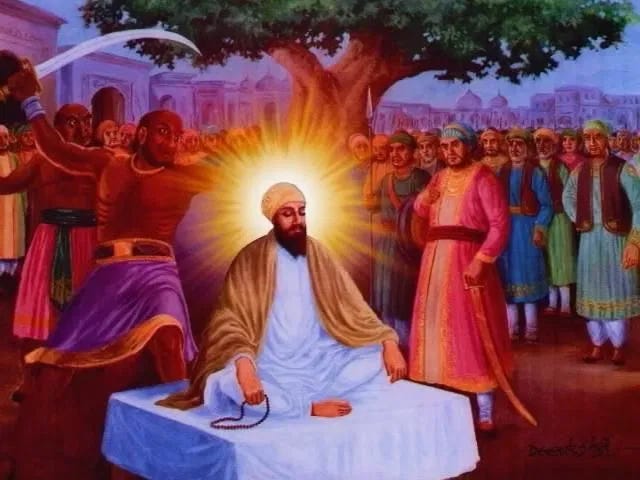
Historical records from Sikh and non‑Sikh sources reveal the context of his martyrdom. When Kashmiri Pandits faced persecution under Mughal rule, they travelled to Anandpur Sahib to seek his help — not for political support, but to defend their right to practise their faith freely. Contemporary Persian accounts, archival Bhat Vahis, and historians such as Fauja Singh and HR Gupta corroborate these events, confirming that Guru Ji stood firmly against forced conversion and oppression.
Imprisoned and ultimately executed by Aurangzeb, he remained unshaken. His courage demonstrated a truth we still struggle to live today: that the defence of human rights does not depend on legal systems — it depends on conscience. Even the jailer Khwaja Abdulla recognized his righteousness and assisted him, illustrating the deep reverence his moral clarity inspired across communities.
In 1675, Guru Tegh Bahadur Ji made an astonishing choice even by today’s standards: he offered his life to defend the rights of a community outside his own tradition. The Kashmiri Pandits were not Sikhs, nor his followers.
They had nothing material to offer. His stand was not strategic or sectarian — it was purely ethical. It declared, centuries ahead of its time, that the freedom of conscience is a universal human right.
Modern institutions describe this using legal vocabulary — freedom of religion, protection from coercion, minority rights, and inherent human dignity. But Guru Tegh Bahadur Ji needed no such frameworks.
He understood that harm to one community imperils justice for all. His martyrdom remains one of the earliest recorded instances in world history of a leader sacrificing himself not for his own people, but to protect the freedoms of others.
It is a moral clarity that today’s global human rights system often fails to meet.
If Guru Tegh Bahadur Ji Were Alive Today
If he were here now, he would recognize the power of today’s human rights tools — the Charter, UN treaties, international courts — yet he would also see their limits. He would remind us that laws are only as strong as the courage behind them.
He would urge Canada to confront the inequalities still faced by Indigenous peoples, refugees, religious minorities, and racialized communities.
He would speak out against forced assimilation anywhere in the world, condemn state‑sponsored oppression, and stand beside those persecuted for their beliefs — whether Sikh, Muslim, Hindu, Christian, Jewish, atheist, or otherwise. He would defend the dignity of the marginalized who lack political influence. And he would insist on a universal ethic: rights must apply to everyone, especially those unlike ourselves.
His message remains the same as it was in 1675: principles mean nothing unless we act on them.
A Call to Action: Human Rights Today — Beyond Courts and Institutions
The modern world believes it invented human rights, yet Guru Tegh Bahadur Ji lived them long before they had a vocabulary. His life challenges us to do something that institutions alone cannot:
To build communities of courage that can withstand injustice, corruption, and modern forms of tyranny.
Human rights organizations, governments, and advocacy institutions today do important work — but many are underfunded, politicized, or influenced by those in power. Corruption, complacency, and bureaucratic caution often blunt their impact. Guru Tegh Bahadur Ji would remind us that justice cannot rely solely on institutions that are themselves vulnerable to pressure.
So what do we do?
We build strong, principled communities. We speak up when others are silent. We show up for groups facing discrimination even when we don’t belong to them. We educate, organize, protest peacefully, protect each other, and refuse to normalize injustice — whether it targets Indigenous land defenders, refugees at borders, religious minorities abroad, or racialized communities at home.
The Guru’s example teaches us that tyranny is never overthrown by institutions alone. It is overthrown when ordinary people unite across differences, grounded in conscience, courage, and a commitment to universal freedom.
The term “human rights” may be modern, but the spirit behind it is ancient. And few in human history embodied that spirit as profoundly as Guru Tegh Bahadur Ji.
On this Gurpurab, his legacy challenges us to move beyond admiration into action — to defend dignity wherever it is threatened, and to become the guardians of the rights we often take for granted.
Centuries ago, Guru Tegh Bahadur Ji sacrificed his life for the freedom of others and stood up against injustice, even when it wasn't directed at him. In light of this, what are we willing to risk today to defend the rights of those whose voices are silenced, whose freedoms are under threat, and whose dignity is denied again and again?