

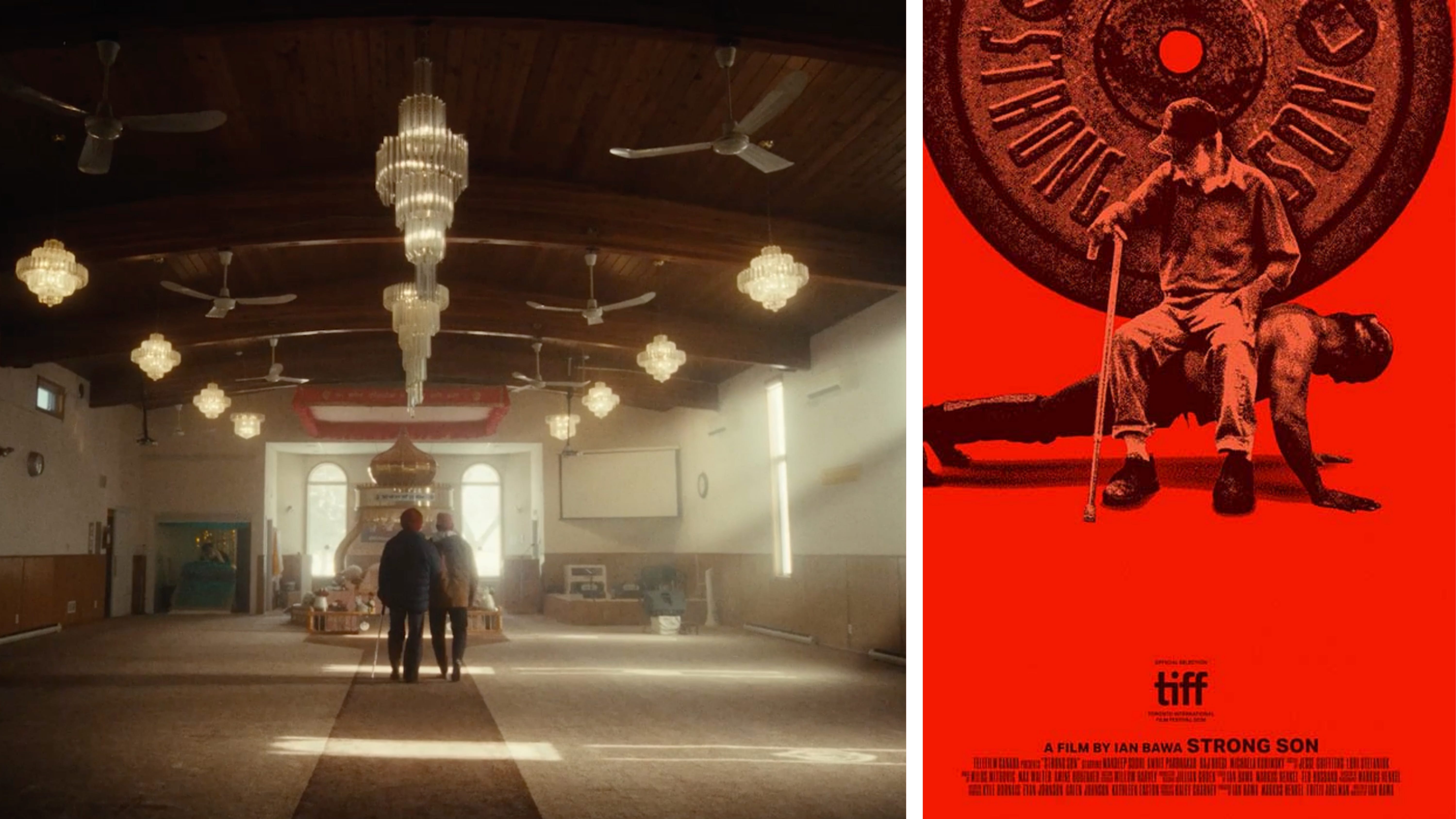
As our parents age, the relationship between parent and child can quietly change. The people who once cared for us may eventually need us to care for them. For many Punjabi and Sikh families, that transition can carry complicated feelings like love, responsibility, guilt, duty and the fear of not being able to do enough.
At TIFF 2026, Ian Bawa’s Strong Son offered a deeply personal story about family, grief, masculinity, caregiving and mental health, centred around a Sikh and Punjabi cast.
It was one of the first times I have seen Sikh and Punjabi men on screen given the space to openly experience anxiety, sadness and vulnerability without immediately having to hide it.
For many brown men, emotional openness is not always encouraged. We are often taught to work, provide for/protect our families, and to keep moving.
There is little room for admitting that something hurts. Strong Son explores what happens when that expectation becomes impossible to maintain.
The film follows Harvinder “Harvey” Singh, played by Mandeep Sodhi, as he returns to Winnipeg to care for his aging father, Jagdeep, played by Amrit Parbhakar. Harvey looks physically strong. He spends hours in the gym building his body, but internally he is carrying grief, anxiety and responsibilities he does not know how to process.
That contrast gives the film much of its emotional centre. Harvey can work on his physical strength, but he cannot simply lift his way out of how he feels. The gym becomes an escape, a place where he can focus on his body when his mind feels out of control.
The wrestling storyline adds another layer. While wrestling was not part of Ian Bawa’s own experience, it gives Harvey a physical outlet for emotions he has been struggling to contain. Inside the ring, aggression and emotion have somewhere to go. It becomes another way of asking what strength actually looks like.
The film’s depiction of Harvey’s panic attacks was particularly effective to me. They are not presented as dramatic moments where someone immediately arrives to make everything better. Harvey is often completely alone, left to sit with what is happening inside his own body.
Then someone who genuinely cares notices. That felt very real to me. Mental health struggles can be invisible until someone takes the time to actually see you.
Harvey’s relationship with his father is sometimes funny, sometimes uncomfortable and deeply familiar. Jagdeep talks about needing “strong legs” to work and find a woman to marry, while trying to set Harvey up with women wherever they go. Beneath the humour, however, is a father who expresses care through expectations, instructions and practical advice rather than emotional reassurance.
Some of my favourite moments are the quieter ones.
Watching Harvey put his father’s pagh on and take him to the gurdwara says so much without needing a long explanation. These scenes show Sikh family life naturally, while revealing the tenderness between father and son.
Another contrast that stayed with me was when Harvey spends his days working security, protecting and watching over others, and his nights caring for his father. He is expected to be dependable while privately struggling himself.
The story is closely connected to Bawa’s own life. Strong Son began as a three-minute Super 8 short at TIFF in 2020, starring Mandeep and Ian’s father, Jagdeep Bawa. After Ian’s mother died when he was around 19, he began going to the gym because he was afraid he would die too. His father would sometimes sit and watch him work out.
Ian also told me about a moment after a difficult breakup when he started crying in front of his father. His father responded, “Don’t cry, be a man, be strong.”
That experience became part of the film’s larger exploration of masculinity and the expectations placed on men.
Mandeep carries that tension beautifully. Harvey continues through ordinary routines even when he is clearly falling apart. The crying scenes are particularly powerful because the film does not rush to fix him.
Speaking about Mandeep’s performance, Ian told me, “Those are real tears.”
The film also avoids making grief entirely serious. The awkward conversations, matchmaking attempts and everyday tension between father and son create humour without taking away from the emotional weight. These moments make them feel like a family rather than characters constructed to tell a story about mental health.
Ian’s father also appears in the film initially. He had never acted before and was legally blind, but Ian told me he delivered his lines naturally, like a real Punjabi father. That authenticity comes through. Jagdeep is not simply a difficult or emotionally unavailable father. He is someone shaped by his own experiences, limitations and understanding of what it means to be a man.
After the original short, Ian made My Son Went Quiet and The Best, eventually bringing those stories together with the first Strong Son short to create the feature over approximately five to six years.
Ian told me, “This film is very much about the issues I had in my life.”
That personal connection is evident throughout. The film does not feel like a distant examination of mental health. It feels like someone working through memories, family expectations and unresolved questions.
The Sikh/Punjabi representation is particularly meaningful. Punjabi men are often associated on screen with strength, faith and physical presence, but less often with grief, panic, caregiving and emotional exhaustion. Strong Son allows them to be complicated, imperfect and vulnerable.
Ian also spoke about growing up in a family that wanted him to assimilate into white Canadian society. He was named Ian, was not taught Punjabi and felt disconnected from the Sikh community while still identifying as Sikh and South Asian. His films are rooted in universal experiences, but they come from a very specific Sikh and Canadian perspective.
Raj Dhesi, known professionally as Jinder Mahal, adds another interesting layer. Ian explained that Raj initially auditioned for Harvey, but was ultimately placed in a role that plays with the assumption that a physically imposing man must be aggressive.
Instead, his character is kind and willing to ask Harvey whether he is okay.
In Strong Son, physical strength and emotional strength are not the same thing.
The film also connects to chardikala. During our conversation, Ian told me, “Some of us are fighters. We cry so badly sometimes.”
That line stayed with me.
Resilience does not mean pretending you are fine. There can be faith and struggle at the same time, just as there can be strength and vulnerability.
But the moment that stayed with me most came near the end, when Harvey has to leave his father in long-term care.
There is a particular kind of guilt that can come with caring for our parents. They raised us, sacrificed for us and did the best they knew how. When circumstances reach a point where you can no longer care for them yourself, leaving them somewhere else can feel like you are abandoning the person who spent their life taking care of you.
That ending reminded me of my own reporting on Niwaas Long-Term Care, a planned Punjabi Sikh long-term care home in Brampton. Its vision of providing professional care while keeping elders connected to their culture, faith and community made me think about what culturally familiar care can mean for families like Harvey’s.
For Punjabi and Sikh families, long-term care is not only about providing a place to live. It can also be about understanding an elder’s language, food, faith, routines and sense of community.
That is where Strong Son becomes bigger than Harvey’s story. It raises questions about what we owe our parents, what caregiving looks like when families are stretched beyond their limits, and whether the systems around us understand the people they are caring for.
What stayed with me was the accumulation of small moments: a son putting his father’s pagh on, taking him to the gurdwara, caring for him at home, working security during the day, going to the gym, finding an outlet in a wrestling ring and then quietly falling apart.
Strong Son is not simply a film with Punjabi actors. It is a film where Sikh Punjabi men are allowed to be sons, fathers, caregivers and people who sometimes do not know what to do next.
Ian told me he was curious about how the Sikh/Punjabi and South Asian community would respond to the film.
He described the response as “very nice and important,” and said, “No one has shown this; that’s what makes it interesting, and it’s real.”
I think that is what makes Strong Son meaningful.
It does not offer an easy solution to grief, masculinity or family expectations. Instead, it makes room for uncertainty, vulnerability, faith, humour and the reality that sometimes being strong simply means allowing yourself to feel.
Most importantly, it reminds us that being human has to come before performing the role of the strong son.