

I watched Zohran Mamdani’s mayoral inauguration from Canada, but emotionally, I was in New York — a city that has always loomed large in the Sikh imagination. For work. For migration. For survival. For struggle. For aspiration. And this time, for something else: recognition.
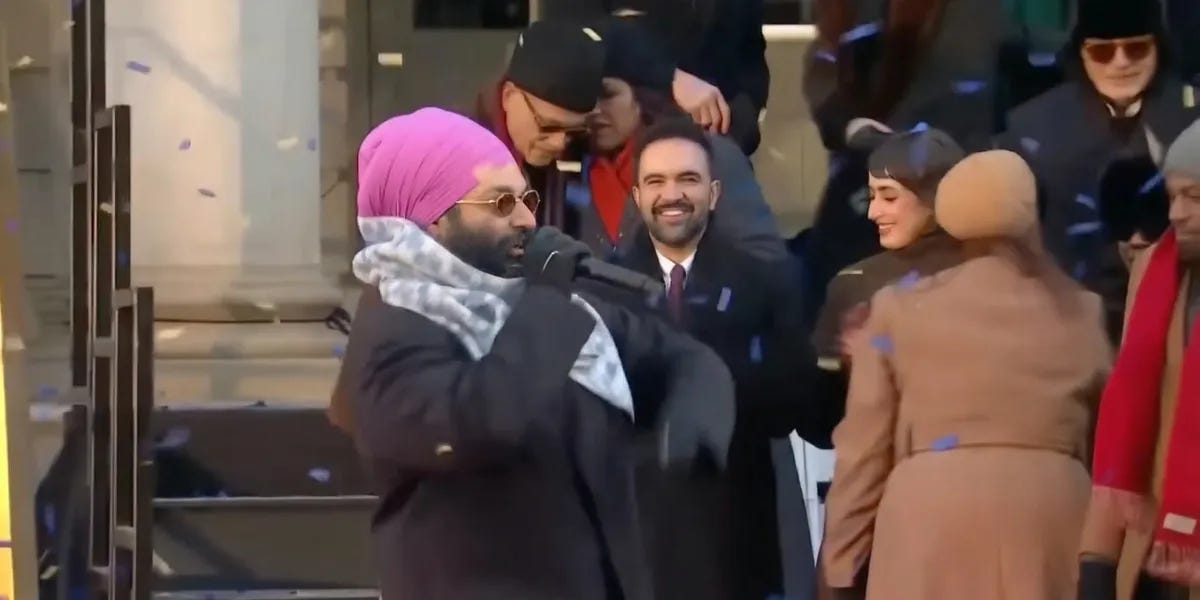
What struck me almost immediately — even through livestreams, photos, and shared clips — was the sheer number of Sikhs present. Not just present, but visible. In the crowd, on the steps, woven throughout the ceremony. Turbans of different colours. Beards worn without apology. Families, elders, artists, activists. It didn’t feel accidental. It felt like people understood the weight of the moment and chose to show up for it.
On stage, that visibility was unmistakable. Tandeep Kaur stood during the interfaith moment, calm and grounded, representing the Sikh presence not as an explanation or outreach exercise, but as a matter of belonging. Babu closed the ceremony, his performance echoing through City Hall as confetti fell — Punjabi lyrics filling a space that has historically symbolized state power.
And then, in the crowd, I noticed faces many Sikhs recognize immediately: Simar Jeet Singh, Vishavjeet Singh, and Waris Ahluwalia. Writers, artists, and cultural figures whose public lives have unfolded alongside — and often in resistance to — the post-9/11 racial climate in New York. Seeing them there wasn’t incidental. It told a story about continuity.
As a Sikh journalist, I don’t experience moments like this as isolated wins. I experience them as interventions — into memory, into history, into power.
To understand why this inauguration felt so heavy with meaning, you have to remember what New York was like for Sikhs after September 11, 2001. This city became one of the epicentres of racial backlash, surveillance, and state-sanctioned suspicion. Punjabi Sikhs — many of them recent immigrants, working as taxi drivers, construction workers, shop owners — were among the first targets of hate crimes.
Sikh men were beaten in the streets. Turbans were ripped off. Gurdwaras received threats. Taxi drivers were assaulted. Some were killed. None of this happened in isolation — it was part of a broader system that collapsed brownness, Islam, and foreignness into a single threat. Sikhs paid the price for a war narrative they had no part in creating.
Systemic racism followed the violence. Surveillance programs, policing practices, and media narratives reinforced the idea that Sikh and Muslim bodies were inherently suspicious. We were questioned at the borders.
Followed in airports. Treated as problems to be managed rather than communities to be protected. Visibility became dangerous. In many cases, survival meant shrinking.
That history doesn’t disappear just because time passes.
Which is why Zohran Mamdani’s election already felt significant. A Muslim mayor of Indian-Ugandan descent, shaped by immigrant life, anti-surveillance politics, and organizing among working-class communities, now leads New York City. For people long treated as security risks rather than political authors, that alone signals a shift in who is trusted with power.
But the inauguration went further.
During the interfaith segment, Tandeep Kaur’s presence carried weight precisely because it wasn’t defensive. She wasn’t there to explain Sikhism, condemn violence, or reassure anyone of our harmlessness. She stood there as part of the city’s moral and civic fabric — untranslatable, unapologetic, steady.
As a Sikh, that mattered deeply to me.
Too often, Sikh inclusion in public life comes with conditions. We are welcomed when we provide service, when we respond to hate, and when we perform gratitude. Rarely are we invited simply to exist — especially in moments tied to celebration and power. That’s what made this interfaith moment feel different. It wasn’t asking for acceptance. It assumed belonging.
Then Babu took the stage.
His performance didn’t sanitize Punjabi culture or flatten it for comfort. It carried humour, bravado, confidence — the same energy that has fueled the Punjabi-Canadian music scene from Brampton basements to global charts. When he reworked Gaddi Red Challenger to name New York, it wasn’t a gimmick. It was a declaration: we move through cities now, and the cities move with us.
When cameras caught Simar Jeet Singh, Vishavjeet Singh, and Waris Ahluwalia in the crowd — men who have each endured post-9/11 profiling, media stereotyping, and institutional resistance — the generational arc became clear. This wasn’t just about one artist or one mayor. It was about survival turning into authorship.
From a journalistic perspective, what struck me most was how unforced it all felt. The performance wasn’t hidden at the margins. It closed the ceremony. Sikh presence wasn’t explained or justified. It simply existed.
That ease is rare for a community whose public visibility has so often been shaped by fear, racism, and the threat of violence.
As someone who carries both a kirpan and a notebook — faith and responsibility — I felt pride, but also weight. Representation is never neutral. When one of us steps onto a global stage, they carry a community that has learned to be cautious about being seen.
Repping the community, to me, isn’t about being perfect. It’s about refusing to shrink in spaces that once demanded our silence.
Zohran Mamdani’s role in all of this is central. His election represents a city willing to confront — not erase — its racial history. A city that once policed Sikh and Muslim bodies now entrusts leadership to someone shaped by those histories of exclusion.
From Canada, that contrast is uncomfortable.
We celebrate multiculturalism, yet our civic rituals remain cautious. Faith is accommodated, not integrated. Diaspora culture is welcomed at festivals, not entrusted with narrative power. We like diversity — as long as it doesn’t unsettle.
New York, in this moment, allowed itself to be unsettled — and looked stronger for it.
This inauguration didn’t erase systemic racism. It didn’t undo hate crimes. It didn’t guarantee safety tomorrow. But it did something essential: it changed what the center of power looked and sounded like.
For young Sikhs watching — in New York, in Brampton, in Surrey — seeing Tandeep Kaur and Babu on stage, and Simar Jeet Singh, Vishavjeet Singh, and Waris Ahluwalia in the crowd, expands what feels possible.
As a Sikh journalist, I believe representation matters most when it doesn’t ask for applause — when it simply exists, confidently, in spaces that once excluded us.
On January 1, 2026, New York offered a glimpse of that future.
Not as a spectacle.
Not as tokenism.
But as a city finally comfortable enough to let its people tell the story together.